Showing posts with label Geoffrey Rush. Show all posts

Tuesday, May 24, 2011

Pirates of the Caribbean: On Stranger Tides *


Director: Rob Marshall
Cast: Johnny Depp, Penélope Cruz, Geoffrey Rush
Ian McShane, Kevin McNally, Sam Claflin
Àstrid Bergès-Frisbey, Richard Griffiths

Given how excruciatingly terrible the two last installments of the Pirates of the Caribbean saga had been, it was perhaps reasonable to expect that a fourth chapter would only be created in order to improve the series. This wasn't the case. On Stranger Tides in fact might be the worst of them all and if you've seen the other ones, you understand this is saying a lot.
Johnny Depp is back to play Captain Jack Sparrow, by this point however he seems to have become so uninterested in the character that he plays him on autopilot. Sparrow still delivers witty lines and acts like he's drunk; however by now his quirks have just become preposterous and fail to add shades to this character.
This time around Sparrow gets dragged into an expedition to find the Fountain of Youth that Ponce de León had set out to find two centuries before. Sparrow's expedition is led by the evil Blackbeard (McShane) and his newfound daughter Angelica (Cruz) who also happens to be Jack's former flame.
Of course things won't be just that easy for Sparrow and crew, given that two other teams have set out to find the fountain. One of them is led by Sparrow's perpetual enemy Hector Barbossa (Rush), the other by Spanish conquistadors. Somewhere within the movie there are inklings of a political statement meant to have been suggested with these multicultural races towards advancement.
This might be looking too much into the film's flawed screenplay though, given that so little happens over such a long time that your mind might wander and try to find things to rescue about this production.
Many questions might arise, like: why does such an expensive film feel so cheap at every turn? The visual effects fail to impress and at moments look almost dated. What are actors like McShane, Rush, Depp and Cruz doing in such a film?
Rush as usual injects Barbossa with a manic wickedness, while McShane is given so little to do and it's such a shame given his talent for delivering villains. Cruz remains enjoyable throughout the movie and is perhaps the only cast member who never seems to get bored by the ridiculous levels the plot reaches. She somehow seems to be having fun and in one of her last scenes is even able to find something that feels like an emotional core of sorts.
The biggest enigma in the film though, might be why is it so dull? From the beginning, when it throws complexly choreographed sequences at us (one even contains a Judi Dench cameo!), everything feels like something we've seen a million times before and never really liked to begin with.
While the first installment in the series brilliantly exploited the film's amusement park origins, this one feels like a very long ride down an attraction someone forgot to make fun. How can something so big, be so little fun?
Despite the film's loudness, it's almost impossible not to drift while watching it. Perhaps director Marshall tried to see too much into these characters and situations? For there is not a single character who doesn't suggest a richer backstory than they deserve (something Angelica mentions about a convent might've been a better movie than this one...) and for all these comments about past stories we get truly ridiculous attempts at humanizing these people even more. Marshall then gives us a boorish love story between a missionary (Claflin) and a mermaid (Bergès-Frisbe). He's looking for faith, she's not one of "god's creatures" and before long we have even more winks about religion by way of the conquistadors who speak exactly three Spanish words in the film.
There's dozens of plot holes, setpieces that go on and on and on without any purpose and an overall disturbing feeling of coins falling into Disney's own treasure chest. Not even Cruz's own phenomenal chest makes this any better.
Pirates of the Caribbean: On Stranger Tides drags for so long, giving so little that by its end you will wish you found the fountain of youth, if only to recover the hours you lost watching this.

Sunday, January 30, 2011

The King's Speech *½


Director: Tom Hooper
Cast: Colin Firth, Geoffrey Rush, Helena Bonham Carter
Guy Pearce, Eve Best, Michael Gambon, Timothy Spall
Jennifer Ehle, Claire Bloom, Derek Jacobi

It seems that for as long as there have been movies, that's how long their need to convince us they're just like us, has existed.
Why have most movies lost the need to revel in their own cinematic-ness? Why such a need to make us identify with them?
If you're looking for answers to those questions you might as well stay away from The King's Speech, a film so secure about its heart-tugging contrived maneuvers, that it dares to pretend it's a story about the every man when in fact it's a piece of ideological brainwash that reinforces the notion that the people watching it are precisely the exact opposite of what they're watching onscreen.
The film basically deals with King George VI's struggle with stuttering. We see him shame his father (Gambon), be bullied by his brother (Pearce), be nurtured by his wife (Carter) and eventually be cured by magical Australian Lionel Logue (Rush) before delivering the speech that, according to the movie, mattered more during WWII than the tons of lives lost afterwards.
The film is handsomely made but it's slightly offensive to think that more thought was put on the details in Helena Bonham Carter's hats, than in the way the film relishes in its somewhat fascist ideology.
With each new scene we see how more and more it's buying its own love for royalty and its seemingly "human" approach (awww it's tiny Queen Elizabeth!) is nothing more than a reaffirmation for the film's condescending look at the world that surrounds it.
As Hooper and company fail to find anything to question about the characters, these become puppets at the command of a modern fairy tale that pretends to exalt humanity when all it does is trivialize war in the face of royal adversity.
Sure, the king's achievement was notable and a triumph on its own, and sure, the fact that the people around him congratulate him on his success and seem to forget about the larger reality outside Buckingham Palace is quite normal, what's baffling is that the film fails to question these things.
It comes as no surprise that the film's best performance and its biggest asset comes in the shape of Eve Best as crown wrecker socialite Wallis Simpson; it's through her that we get the only glimpse of seeing what lied beyond the crown, beyond the obligations and especially beyond the facade.
If it wasn't for her we'd be stuck with a bunch of people who use their status as means to demean other- when Queen Elizabeth pokes fun at commoners who feel surprised to meet her, it's not really cute, it's disturbing- and as much as the film tries to make Lionel and the King achieve some sort of Becket like synergy, not such relationship is truly ever formed.
We are presented with a portrait of a group of gorgeously lit saints whose own personal troubles amounted to more drama than the Blitz and while some might get a kick out of watching the intimate lives of royals, their lives here are so restrained by public relations that this doesn't even serve as royalty porn, its purpose was never to allow us into their lives but to perpetuate the sort of ideology that can pass patronizing as back patting.
For a film that deals so much with communication, it's a shame that The King's Speech muffles the audience's voice so much.

Saturday, December 4, 2010

Sheet-y Saturday.

Where we take a look at posters for upcoming features.


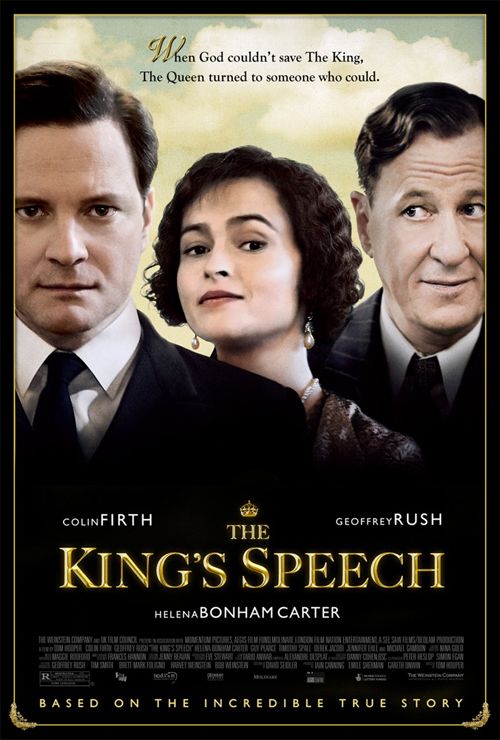
After the truly hideous design the marketing team over at the Weinstein Co. had made for The King's Speech, it's refreshing to see they finally came up with something that's not only lovely but also brilliantly executed.
Colin Firth's lips look thinner than usual and very well represent the dilemma at the center of the plot, notice how the microphone coming from above actually seems to evoke something godly and how the entire thing is a version of Michelangelo's famous painting of God and Adam atop the Sistine Chapel.
I'm thinking that the Weisnteins redid their campaign because they must know what ugly posters can do to Oscar movies...


I have to confess when it comes to documentaries I'm the most unversed person alive. All I know is Michael Moore, some Errol Morris, Herzog (LOVE his docs!) and a slew of the preachy stuff that always win Oscars.
However I have never seen what some think of as the greatest documentary ever made: Shoah.
When it comes to it I tend to think like Annie Hall "four hours of suffering!" but seeing how it's getting a new release I'm wondering if I've truly been missing out on something great?
Have you all seen it, should I stop being lazy and rent it?

Also, kudos to my friend Andrew for spotting this.
He gets the honorary Sheet-y Saturday badge of honor.

Tuesday, February 12, 2008

Elizabeth: The Golden Age **


Director: Shekhar Kapur
Cast:
Cate Blanchett
Clive Owen
Geoffrey Rush Abbie Cornish Samantha Morton

It is the year 1585 and Queen Elizabeth I (Blanchett) faces some of the most difficult times in her reign.
The Vatican has begun a Holy War against all impure religions and Protestant England is the biggest enemy.
Spanish King Philip II (Jordi Mollá) has begun to conspire against Elizabeth with the help of her cousin Mary Queen of Scots (a subtly dignified Morton).
She also must deal with constant pressure from her advisors about remaining unmarried.
Things begin to look better for her when explorer Walter Raleigh (Owen making his best Errol Flynn impression) arrives in the court, stirring her sense of adventure, along with her hormones.
But dutiful to her self appointed Virgin Queen title she channels all sexual desire engaging in war to defeat the Spanish armada and trying to survive in order to lead her country to its eventual Renaissance.
A film completely in love with its own beauty, this "Elizabeth" has lost the brutal beauty of its 1998 predecessor and has dedicated all of its efforts into looking voluptuosly beautiful.
The biggest example might lie in its lead star, by the time depicted in the film, the Queen was in her 50s, yet the only thing that hints at her age might be her menopausic rage and fixation on invisible wrinkles.
Historical accuracy hasn't been perhaps the best feature in Kapur's films, but while in the original one his liberties served as necessary metaphors, here they all are in service of what would make the most extravagant shot or how much soap opera worthy drama the audience can handle.
When it could've drawn interesting parallels with the Holy War and our times, the plot instead worries about how Elizabeth will react when she learns Raleigh has a thing for one of her ladies in waiting (Cornish).
When it could've explored so much about the Queen's internal drama, it chooses to show us how her ladies take care of her wigs. It seems she has one in every style and size, including a long one, complete with tresses for when she must get in armor a la Joan of Arc and inspire her troops with a "Gladiator" speech (No wonder that the young Spanish Infanta has an action figure that looks like her).
The script does a great disservice to the brilliant lead actress; Blanchett must've realized how the grandiosity of the settings and costumes, along with the campy lines, drowned the drama and literally tried to give an even bigger performance.
In some scenes, like when she condemns Mary to death, Blanchett taps into the fear and insecurity that made Elizabeth a person above all things.
But when minutes later she is screaming "I keep my bitches on my collars" you wonder when did Blanchett stop playing Elizabeth and a deranged Norma Desmond arrived to play the Queen of Hearts from "Alice in Wonderland".
A film that promised so much and delivered pure camp, probably doesn't bode well for part three "Elizabeth: The Golden Girl".